

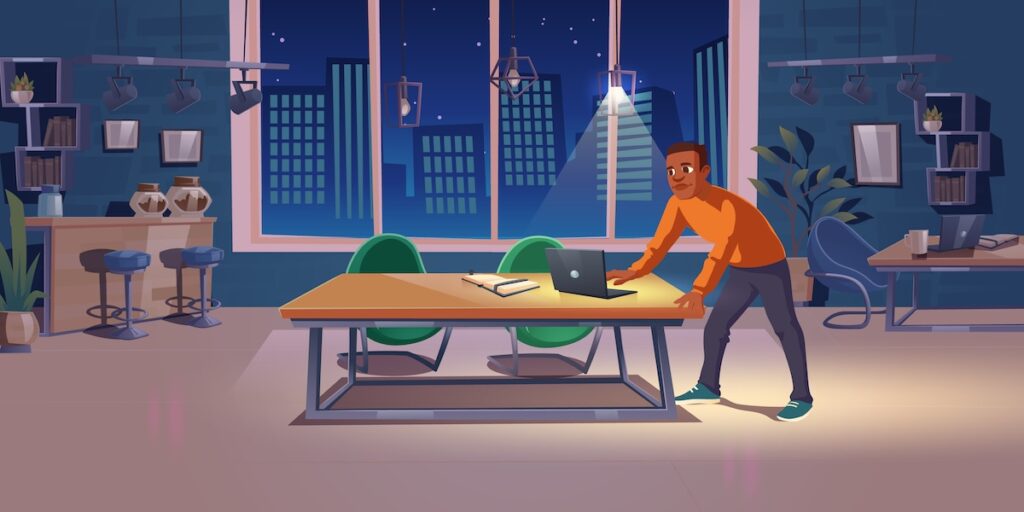
People love to romanticize the idea of having a “big career.” They picture the glossy stuff: the fancy title, maybe a corner office, decent paycheques, and the occasional business trip that isn’t totally soul-crushing. Maybe there’s even a little status that comes along with the position. They imagine a little bit of stress, sure, but nothing a strong cappuccino can’t fix.
What they conveniently gloss over is the gritty reality. I’m talking about the bone-deep exhaustion of 60–80-hour weeks. The hum of low-level anxiety that sits just under your skin even on your days off. The pressure you carry like a second skin, and the mental checklist that keeps running 24/7 while you try to sleep. A demanding career—the kind that steals your nights, shapes your days, and takes up all the prime real estate in your brain—is its own kind of life.
And when you’re doing all of that as a solo? It hits differently. I’ve been on both sides: less demanding jobs prior to age 40, married and a new mom. Then, still a partner, raising kids while beginning a big career, and later as a solo with kids almost grown and leaving the nest, in a well-established, incredibly demanding career. It’s tough no matter what. But since I’m coming from the solo perspective, I’m taking the liberty of celebrating and maybe, just maybe, letting out a little whine on all of our behalfs. I’ll also try to cover “How to Balance It All While Married” although clearly, I wasn’t successful there.
When Your Job Moves Into Your Guest Room: The Truth About Work Burnout
Folks with high-stress careers don’t just clock out. They carry their work home like the world’s heaviest, invisible luggage. Even when you’re technically not “on the clock,” your brain is absolutely, irrevocably on.
The reality. Professional careers and entrepreneurial gigs don’t usually hand out an hourly wage. You get an annual salary or a project fee to “get the job done.” There’s no buzzer that says, “Okay, stop now.” The assumption is you’ll do whatever it takes, no matter how many hours that sucks up.

The Solo Trap: No One to Ring the Dinner Bell
Here’s where the solo life flips from a blessing to a boundary-less curse. When you’re alone, there’s no built-in, external interruption to pull you back to real life.
- No one calls you to dinner.
- No partner says, “Hey, close that laptop. You promised we’d watch that show.”
- No one to say, “You’ve worked all day the last 7 Sundays in a row!”
So, you stay in work-mode longer—often much longer—simply because… well…you can. You don’t have to accept “good enough” as your work output because there are still a few more waking hours where you could address the shortfalls. It’s so easy to put yourself last, if you set high standards for your work. It’s especially egregious if you truly have a passion for it, and a strong desire to offer the best product to your clients, boss or in my case, students.
At the time, it feels like glorious freedom. In reality, it’s a lack of boundary enforcement. And trust me, every year I tried to reset those boundaries, but trusting myself alone to enforce them was a losing battle.
When you live alone, there’s no witness to how unhealthy your lifestyle has become. This is the start of a silent, downward spiral that you often don’t see until you’re deep into dangerous territory: skyrocketing cortisol levels, the soul-crushing weight of work burnout, and body-wide inflammation that chips away at your ability to cope, impacting all the imperative systems in your body.
Being sedentary for hours, neglecting your family and friendships, and just plain pushing yourself too hard? My friend, you’re slowly chipping away at your lifespan and/or healthspan, and you won’t get the bill until years later.
The Financial Pressures Single People Can’t Escape
When you’re solo, you don’t have a safety net—you are the safety net.
The stakes of pivoting, pausing, or dropping your demanding job are just too high. Most of us aren’t financially diversified. We cannot afford to have our boss even glance at us and wonder if we’re the weak link. Our entire survival usually hangs on that paycheque.
So, even if we finally realize that a demanding career is toxic, even if we know we’re sacrificing too much, many of us feel utterly boxed in. We’ve invested too much—the education, the debt, the years of sacrifice—to walk away. There are loans to pay, and a less-stressful career might not cover the cost of living solo. We’ve become reliant on those essential medical benefits that our basic healthcare system doesn’t provide and that we are using to their full extent (eye glasses, arch supports, physiotherapy, prescriptions, dental crowns from the stress of nightly teeth grinding…all the tools needed for our aging, declining bodies due to our abuse). And if your compensation package doesn’t include those benefits, you likely have a salary that supports purchasing one. It’s something to consider when entertaining moving to a less stressful, but also lower paid job.
Financial gurus aren’t kidding: for a similar lifestyle, solos typically need to net 70-80% of what a partnered couple brings in. That is a seriously expensive lifestyle.
The Career Sacrifices Mid-life Can’t Fix
If your career routinely demands long hours and depletes you of all energy, physically, emotionally, mentally, heads up…it’s not just romantic relationships that strain.
The Dating Desert
Many people with big careers have a breakup story where the job was a major factor. Or, perhaps more common, the busy career prevented a partnership from forming in the first place.
I remember dating someone post divorce who told me straight up, “Seeing you once a week is only four times a month. That’s not a relationship.” He had a point.
In my defence, if you still have to cram a week’s worth of errands, paperwork, housework, usually 6 hrs of job-related work and also nourish other important family and friendships into your minimal weekend time, where does a new relationship even fit? How do you even water that seed?
I have never been the type to just dump my closest friends or shorten time spent with my adult children, simply due to a new romance. And I don’t believe in the “all or nothing relationship,” so you can probably see what the outcome was in my case.
Another person I started dating in July, remarked one late September day, “You know, you became a completely different person once the school year started again.” Of course I did! Isn’t everyone different during vacation? The demands of starting a new school year are overwhelming. Teachers barely catch their breath until late November, after the first report cards are sent out. There was nothing I could do about that, and he needed to understand it early on. He had bought into the false stereotype that teachers only work 6.5 hours a day—the time they spend with students. He didn’t realize that’s only about 60% of the job. He wanted someone who would make him the center of their world. I couldn’t be that person. So, he moved on.
I’m wondering if the best partner for a person with a demanding career is another person who has just as demanding a job. Then they’ll be relieved that you aren’t asking that much from them.

The Family Regret
We don’t talk enough about the true demands of a career, versus a job which has clear “on” and “off” boundaries. There’s a huge gap in the career advice given to high school students, who need to understand how many occupations fundamentally conflict with having a spouse or children. It may be a politically unpopular thing to discuss, but that won’t erase the reality when it slaps you in the face.
If I’m being perfectly honest, I have to own the fact that, in my experience, the job sometimes had to take priority because the deadlines never ended. And that meant not always being there for the people who needed me. It still kills me to think that, but it’s the truth.
I know I was present more often than not, but there’s no denying that in a demanding role, you will inevitably let people down. You can fool yourself into thinking it’ll be “just this time of year”. If your job requires long hours (sometimes 80 for certain occupations), those painful compromises quickly become a regular feature of life. It takes a generous, understanding spouse to make a marriage work when there is that kind of pull on time and availability.
The Ever-Present Guilt
“Big Career Guilt” is a whole mood, isn’t it?
- Guilt for missing family functions.
- Guilt for not being present enough for your kids, partner, or aging parents.
- Guilt for forgetting an important event because your brain was full of deadlines.
- Guilt that your job contributed to a romantic break-up.
- Guilt when your friends say, “You’ve been so busy lately,” and they’re right—because “lately” has turned into “years.”
- Guilt when we didn’t do as much as our colleagues did
- Guilt when we didn’t meet the expectations our clients had
- and on, and on, and on
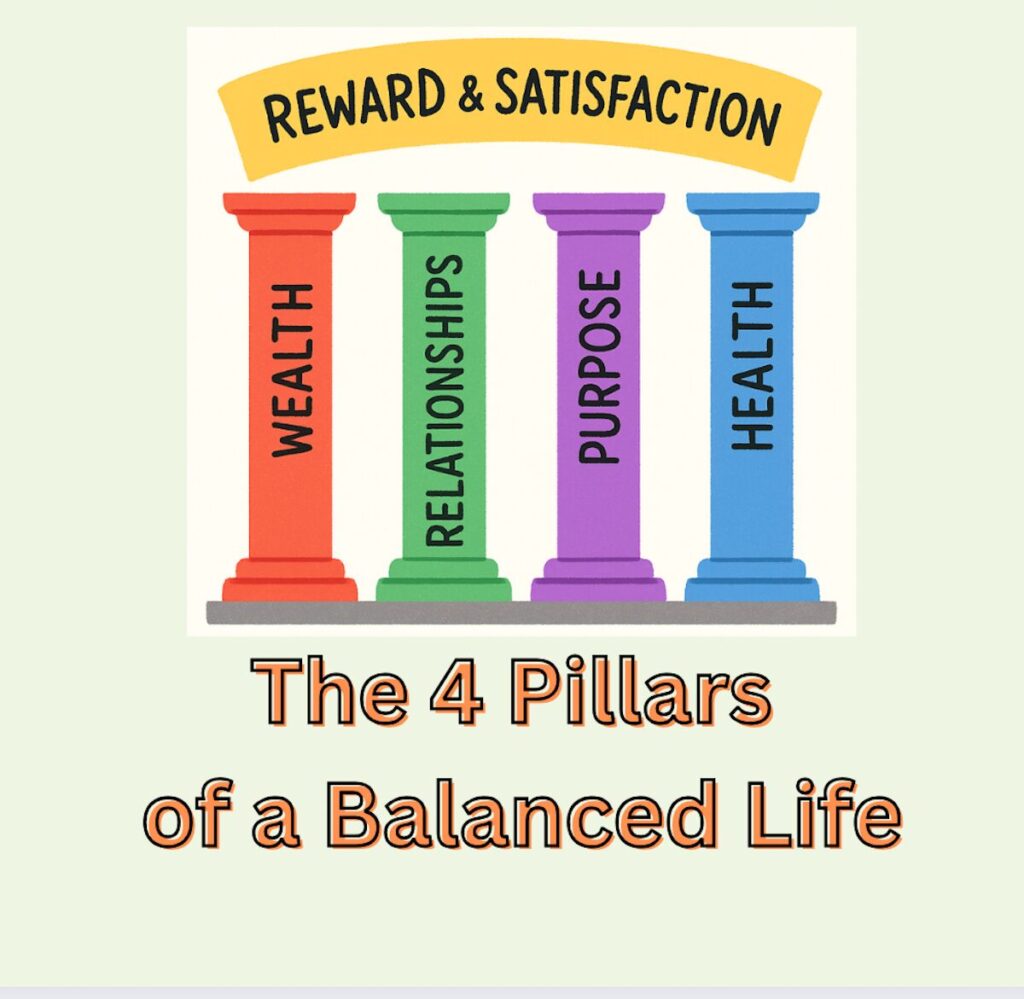
The Four Pillars of a Balanced Life
A balanced life, one that truly makes for a rewarding life can be based on 4 key pillars: earning money to take care of basic needs (we’ll call this wealth), relationships, purpose, and health. They are the source of true life satisfaction, or so they say.
We are so much more than our careers, though in North America, we’re conditioned to tie our purpose almost entirely to our work. I wish we didn’t. It seems like by working on pillar 1 (money), we are eroding pillars 2 (relationships) and 4 (health). At least, from the Boomer and Gen X experience. I see that Millenials and Gen Zs are walking away from the “strong work ethic at all costs” mindset ingrained in our “over 50” psyches. That’s progress.
The Lonely Echo of Success
When you’re solo, the big wins can feel strangely quiet. Promotions, achievements, breakthroughs—they are less celebrated because there’s no one at home who truly, deeply understands the sweat equity you poured into them. Success can feel both empowering and achingly lonely.
Stress, Sleep, and the Health Tab: The Need for Sleep Hygiene
Career stress loves to show up at 2 a.m. Tossing and turning, mind racing, picking up your phone to “quickly” finish one more thing or make a note for tomorrow before we forget — and then painfully trying to rouse ourselves when the alarm goes off much sooner than we’re ready. Regularly getting 5-6 hours of interrupted sleep is a recipe for disaster.
More and more studies confirm that chronic poor sleep shortens your life and prevents your body from repairing itself. Without solid rest, you mess with your sugar levels and increase your risk for cancer, diabetes, heart disease, depression, anxiety, and dementia later in life.
I often read that the biggest fear of many solos is simple: Who will take care of me when I’m sick or old? We feel we simply cannot afford to “go down.” (As an aside, I never understood this concern that is singled out as being a “solo issue”. Yes, I get the sick at this age part, that, I understand. But aging alone? Most women age alone since they outlive their spouse. It’s not a “singles’ issue”. It’s more a women’s issue.) But I digress…
When worrying about becoming sick, we are reminded that it’s critical to look hard at what this demanding career is doing to your body and either change your approach or scale down.
I watched so many colleagues rely on sleeping pills and anti-anxiety meds for years, just to cope with the job. I decided that wasn’t the path for me; I left that job to save my quality of life and be present for my family. Better late than never. It was a deeply personal choice. One I’ve never regretted. You may make a different one, but please, be honest with yourself about the true costs of your job on the other pillars in your life.
Your Immediate Health Check-in
If you’re currently struggling with stress-related insomnia, you need a serious, disciplined sleep hygiene routine. Start tonight. This is what worked for me (and I needed to do all of them, and still do):
- Stop Caffeine anytime after 12 noon.
- No Alcohol or Marijuana.
- Stay Away from Technology for at least two hours before lights out.
- Stop Eating 4 hours before bed (if you’re not diabetic).
- Engage in Quiet Time: Reading, restorative yoga, or meditation in low light in the last hour before bed.
- Keep It Cool: Set your sleeping room to a cool temperature (around 18-19C).
- Buy blackout curtains to block out extraneous light.
- Tape over the small LED lights on devices in the bedroom.
- Get adequate daily exercise.
- Get the proper amount of vitamin D, magnesium and Omega-3s.
- Play some white noise (there are many on Spotify or podcasts).
- and most important of all, set up the automatic “do not disturb” feature for your cell phone.
The Unmatched Advantages of the Solo Powerhouse
As a singleton, I did find there were major, powerful upsides to being solo that isn’t talked about enough. These are the advantages that are unique for solos:
The Career Ladder Can Be a Faster Climb
With no partnership commitments, you have uninterrupted time to take on extra projects, travel for work without debate, and make work your main focus. In competitive fields, that extra 10–20 hours a week compounds into a major advantage over time.
You Are the Master of Mobility
A new opportunity in a new city? You can just… go. There’s no negotiation about whose career takes precedence. Mobility is a huge career advantage, and solos own it.
Financial Independence is Your Superpower
Earning a good salary due to your career means you are in full control of your life. You are nobody’s dependent. You are not stuck. That ability to earn your own way—that independence—is arguably the biggest win of all.
You Forge a Steel Spine
There’s no question that working in a demanding career forces you to become:
- Resourceful and Adaptable
- Confident in a Crisis
- Quick to Solve Problems
- A Master of Prioritization
This life forces you to become deeply, reliably competent. That competence becomes part of your identity, and you carry it everywhere.
The Fundamental Truth Most Overlook (My Henny Penny Moment)
Solos with big careers are usually very capable, responsible, and driven—but also sometimes unseen. The world constantly assumes a support system that, for many, simply does not exist.
For partnered folks, this is their advantage. They may have a teammate willing to pick up some of the slack (with kids, household chores, elderly parents), and contribute financially to their future stability.
For everyone in a demanding career that isn’t just a job to you, I realize it’s the solid backbone of your stability. It’s the source of your pride. The reason you can live the life you live. But it is also the thing that demands the most from you—sometimes far too much.
Your job, in a weird way, can become your closest companion. Your best friend, if you’re not careful. It can become the most meaningful thing you are doing. It’s what gets you out of bed in the morning and makes you feel like a contributing member of society.
That’s great. But what if that is all gone tomorrow?
Who are you now?
Because demanding careers also have a way of isolating you. They warp your perception of what’s truly important and what isn’t. They can be delightful and ominous at the same time.
Who do you matter to outside of your job?
If partnered, is there still a deep bond between the two of you, or are you just a well-oiled machine, existing as companionable roommates who may both be more connected to your careers than each other?
For those who are single, would anybody risk it all to find you, before making their mad escape during a zombie apocalypse?
Or, do you think you’re kind of on your own during massive disasters and threats to human existence?
Answers to these questions have a positive, powerful side and a dark, foreboding side all at once.
But maybe my humble blog article could be a wake-up call to others. It’s time to really examine how you’ve set up your life. What is your true identity?

Is It Worth It? Sage Words From the Other Side of 50
When we let any of those four pillars slip, deep down, we know it. We’re not just letting others down; we’re letting ourselves down. That’s the restless discontent that creeps in as we reach the later stages of our careers. We can’t quite name the problem; we just know the whole damn thing feels a little less exciting, and something’s amiss.
The painful thing is how much we avoid looking at it. We stuff it under the rug. It often takes a major crisis, or finally leaving the career, before we can truly look at just how grossly imbalanced our lives have become.
I can only speak from my own experience. My job is not your job. My relationships are not yours. We are all so different from one another, and value different things too.
We experience the world through our own lens, bring our own emotional baggage, our biased perceptions, and our personalities that make life so different from one another.
Is it worth it? Honestly, only you can decide that for yourself.
But my sage advice is this:
I can’t give you the answer, but I can give you the roadmap: the honest assessment of your four pillars—Wealth, Relationships, Purpose, and Health—is where your decision begins. Start there.
And if you decide you are in need of a midlife pivot, plan for it, imagine it, and see what adventures await you.
Solo community…what in this article resonates with you? Share in the comments.
Check out my YouTube channel by the same name. Perhaps this video on solo travel might be just the thing to get you to stop thinking about work for a while and get inspired to plan an exciting adventure for yourself in the not-too-distant future.


Leave a Reply