

Reading as a Cultural Force
We often treat reading as a personal preference—something you either enjoy or don’t. But reading has never been only personal. Who reads, what they read, and whether they are encouraged to read shapes cultures, communities, and power.
When reading declines, something larger than a hobby disappears.
The New Era of Video Consumption
One of my biggest concerns about our increasing reliance on video media is how narrow our exposure to ideas can become. But it doesn’ have to be if we’re mindful.
I’ve read that globally, people are moving away from reading in favour of the video. Current statistics indicate this to be the case in the US. Canadian reading stats remain largely the same as in the past, if not a slight increase at the current time. I’m grateful for this.
The younger generations indicate that they like the entertainment aspect that seems to come more easily when music and pictures present stories and information. They have to work harder when ‘just reading’. They prefer being able to do more than one thing at a time and there’s no question watching or listening allows for greater multitasking than reading does. They tend to flip between video platforms quickly, with shorter attention spans and less interest in going deep. They prefer to use a device for all their needs (entertainment, information gathering, etc) and there’s no question it’s a little harder to read on a small screen.
The Algorithm Does Not Want You to Linger
Unfortunately, video platform algorithms aren’t built to broaden your perspective. Their purpose is to keep you engaged, comfortable, and continuously consuming content on their commercial platforms. You are being targeted and marketed to. Personal growth is not their priority. Their goal is to boost your viewing time to improve analytics and generate profit. This is how modern communication works—it’s big business.

You are presented only with ideas you already agree with. You receive information that constantly reinforces your existing beliefs. Meaningful challenges to your views are seldom encountered.
Why? Because marketing analysts have discovered that if you are presented with an opposing perspective, there’s a risk that you’ll “move on”, and fast.
Digital platforms reward speed, reaction, and outrage. They do not reward nuance or sustained thought.
Reading, by contrast, asks us to slow down and think independently.
That makes it quietly subversive.
Books Push Back
Books ask for investment. They resist simplification. They do not adapt themselves to our preferences in real time.
That resistance is where growth happens.
A great book—whether fiction or non-fiction—transports you to unexpected places. It introduces you to characters you’d never encounter, ideas you might never have considered, and perspectives that challenge your assumptions, sometimes gently, sometimes forcefully. It has the power to change you, leaving you subtly different than you were just weeks before.
When you read widely, your thinking becomes harder to pigeonhole. You become less easily manipulated by fear-based narratives, oversimplified talking points, or leaders who would prefer you not think too deeply about what you are being told.
Reading keeps you intellectually sovereign. And that matters more than ever.
It is essential that, as the older generation, we pass this mindset on to our younger family members and loved ones. Each of us has a responsibility to instill a belief in the value of books in the youngest members of our community.
Critical Thinking: Avoid Manipulation
Access to the Internet is a double-edged sword. It brilliantly delivers books, essays, magazine articles, newspapers, journals, academic papers, and speeches from around the globe right to our fingertips. It also offers us vastly greater access to literature than the limited selections of local bookstores and public libraries.
But there is still an algorithm that may or may not become the gatekeeper to what we are reading. We need to intentionally seek out variety and find all arguments and perspectives to any given subject we are reading about. It still takes critical thinking on our part to ensure we aren’t being manipulated by a search engine. But maybe that’s great! More cognitive stimulation to keep our brains young. You have to stay sharp to keep informed. Bring it on!
Literacy as a Hard-Won Right
Access to books has never been accidental. Historically, literacy has been restricted because it grants power—the power to question, to imagine alternatives, to resist oppression.
History matters. As parents and grandparents, don’t assume schools are still teaching this important history. Take it upon yourself to share it with your children and grandchildren. There’s no harm in them hearing the same lessons both at home and at school, but there is a greater risk if they never learn this history at all.

Boys, Books, and the Men They Become
This is the part that makes me quietly sad. Fewer boys and young men are reading. Many report loneliness and disconnection, yet spend hours in isolated digital spaces.
As a former educator, I learned that boys are far more likely to become readers if they see the significant males in their lives, reading. Male role models make all the difference.
That is why it moves me so deeply to see books lying casually on the tables in my son’s and son-in-laws’ homes. I trust that their children will grow up knowing that reading belongs to everyday life.
Books, Libraries & Their Value
Bookshelves in school libraries are shrinking to make room for computer stations and STEAM tables (STEAM – Science, Technology, Engineering, Arts, and Math). I’ve seen this firsthand. In my final years as a teacher, fewer students chose to check out books during library visits. Many parents requested that no more books be brought home because they were often misplaced and left unread. And yet, with a show of hands, at least 50% of the students in my class indicated that they had no books in their homes. Librarians, frequently occupied with running tech programs, had less time to nurture a love of reading in students. Older students often conducted research in classrooms using Chromebooks, reducing the need to visit the library.
I’m not saying these programs and spaces aren’t important—they absolutely are. Schools must adapt to a changing society. However, we shouldn’t close the door on reading for pleasure or overlook the invaluable role librarians play in connecting young minds with the richness found within books. We must not discard the value of books along with these changes.
Books have long been, and will continue to be, artifacts that capture moments in human history, documenting thoughts, practices, and lifestyles for generations. Digital spaces are often too transient; outdated files are regularly deleted to make room for new content, making them less reliable for preserving history. Books offer a permanence that digital media cannot match and deserve to maintain their important place in our society.
Books are expensive, and many people now consume most of their entertainment and their news or instructional how-to’s through online video. The explosion of content and the switch in focus of consumers to video sites such as TikTok, Facebook, Instagram and YouTube are the evidence.
But it doesn’t have to be that way. Public libraries lend books for free, with many eliminating late fees to make access even easier. Audiobooks can be downloaded online using your library membership card. Some neighbourhoods have informal community book depots. All of this is available to you at no charge!
Why not propose a monthly Free Books Day where colleagues bring in a book they’ve recently enjoyed and leave it on the staff room table for others to pick up? These simple activities require minimal effort to organize and can inspire everyone to revisit great stories and spark new conversations.
I firmly believe children taken to the local library and exposed to rich, quality literature, gain a sense of wonder and a lasting passion for books—something I fear may soon be lost.
Community Spaces
I grew up when the library was more than a place to borrow books.
It was a refuge for people looking for work. A lifeline for new parents desperate for adult conversation. A safe after-school space for kids. A place where seniors could sit among other citizens and feel less invisible. A hub for service clubs to gather with their monthly guest speaker series, and babysitting courses were offered for teens.
New Canadians would come to practise their English speaking skills and learn all the nuances of an unfamiliar culture in a safe place. If I had moved to a new country, with a vastly different culture to mine, it’s where I would have chosen to hang out too if that was what was offered.
As a kid, the public library in my neighbourhood was my second home (shout out to Brookbanks Public Library in North York, if it still exists). I spent most Saturdays hanging out by myself, without a parent in attendance. It was my favourite place to be and I’d be there all afternoon.
The librarians were kind and knew me well. Years later, I would often take the bus and subway to do all my school work at the Toronto Reference Library, near Yonge & Bloor. I loved the quiet atmosphere, and the vast collection.
Libraries quietly model purposeful living. They show young people that adults read, learn, and engage with ideas across a lifetime. They provide a place to belong without obligation. We lose all of that when libraries become optional instead of essential.
And libraries need books as well as all the digital resources in the 21st century. They teach us how to think, how to live alongside one another, and how to imagine something better.
My Impractical, Impossibly Idealistic Dream Bookstore
I know this will never happen. But indulge me.
If I won the lottery—I would need millions—I would open an independent bookstore. A completely impractical business model, sustained entirely by the fact that I wouldn’t need it to make money.
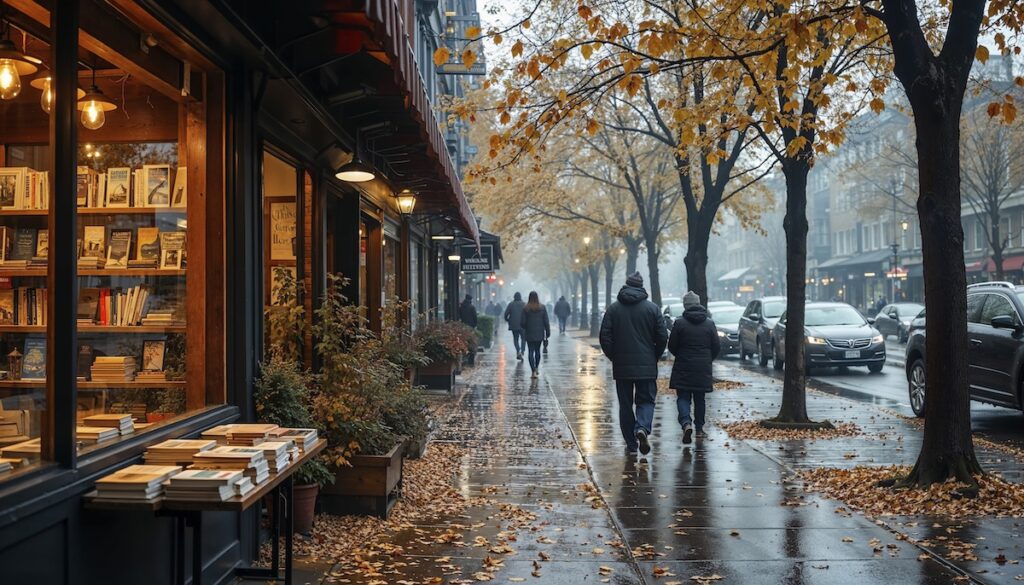
Books would fill every corner. Cozy chairs. Quiet nooks. Housed in a charming older building full of architectural character, it would sit on a picturesque main street in the heart of a lovely small city or bustling town. I’d choose a whimsical name for the shop—one that everyone would recognize and love.
My dream space would feature expansive windows and a warm, inviting interior. Original exposed brick, would add character and charm. At the center, a large community table carved by hand from a magnificent old tree would comfortably seat ten. It would be adorned with daily newspapers, freely available for anyone seeking a peaceful moment of quiet learning.
There’d be chill music and a staff of passionate book lovers eager to engage with patrons. Regulars would visit week after week, dropping by to say hello and discover what new titles had arrived. Of course, there’d be an informal lending shelf for regular customers who need a book but want to avoid the cost. Naturally, there would also be a book club and a writer’s circle.
It would be a place to linger. To talk. To recommend titles to strangers who might become friends. A sanctuary from what will be a world overshadowed by AI and all the machines that supposedly will be embedded in our future world. It would be a place only for human interaction and thought. Quiet reflection and relaxation. Maybe a throwback to a simpler time for some.
Because books, at their best, build community. Would you become a regular visitor to my bookshop if I had one?
So What Am I Reading This Week?
I struggle to keep my reading to just one book. I’ve forever got my name on holds lists at the local library. I’ve been a daily reader for years, but it just continues to grow now that I have the time. I have leaned toward non-fiction in general, but I’m doing my best to try to even out the balance. So, this week is all about fiction for me. My snapshot includes: Digital Fortress by Dan Brown (my book club’s choice for this month) and The Personal Librarian by Marie Benedict (a re-read).
But my favourite this week is a book out by a new Canadian writer entitled “Cruising” by S.A. Thorne. I just love to support our Canadian authors. It’s a fun romcom about a jaded camera operator stuck filming a dating show on a cruise ship, the first of a 3-book series. It’s culturally relevant, filled with humourous interactions, and has touching moments too. A great read for a cozy Sunday afternoon.
What Is Worth Protecting
When we stop reading, we do not just lose books. We lose depth, history, culture. Books may be the only artifact left behind in some future century if the grid goes awry.
That feels worth protecting to me.
Why not read the first article in my series on reading, “Why Reading Still Shapes a Rich Life“, this one discussing why reading still shapes a rich life—for brain health, emotional depth, and a richer inner life.
Check out my YouTube Channel. Here’s one video, but I have lots that cover a wide variety of topics https://www.youtube.com/@soloincanada
Leave a Reply