
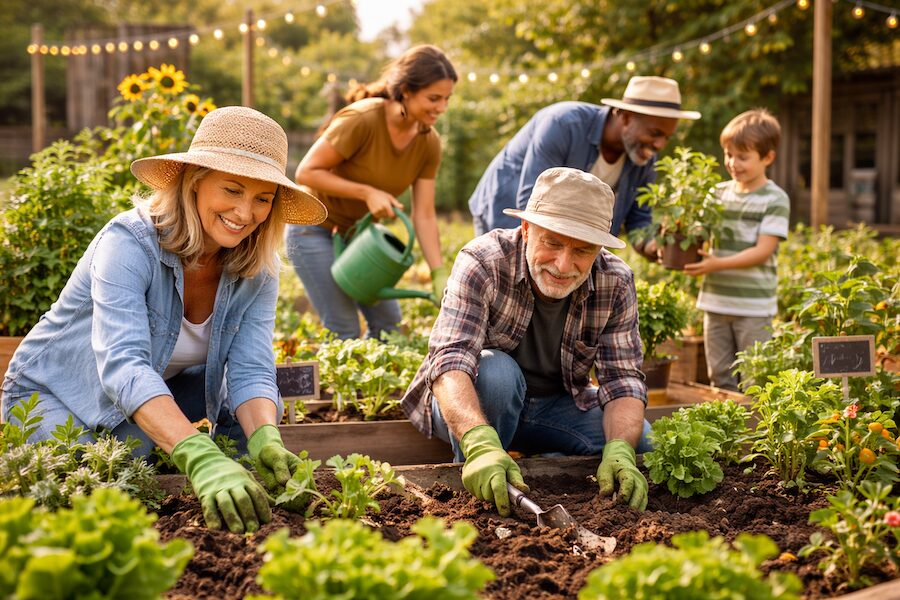
There’s a moment that many of us eventually arrive at — often somewhere after 50 — where we look around at the life we’ve built and realize something important: we’ve been so busy achieving that we may have forgotten to actually design our lives. The career got built. The family got, or is getting, raised. The mortgage was managed (sloppily perhaps but it’s somewhat intact). And now, standing on the other side of all that striving, we find ourselves with a beautiful opportunity — the chance to be intentional about how we live from here on out. I’m talking about creating a balanced life.
Because here’s what I’ve come to believe: a joyful life isn’t an accidental life. At least it isn’t accidental for all but the luckiest few. It’s a designed one. It needs to be worked on, intentionally steered. It’s just that most of us haven’t the time or mental space to do that.
I’m a firm believer that one of the most powerful things you can do to create lasting joy is to make sure your life is genuinely balanced — not in the sense that every area gets equal time and attention, because that’s not realistic — but in the sense that all the important areas are present and tended to. When one area quietly falls away, or slowly gets crowded out by the busyness of everything else, life starts to feel a little hollow, even when things on the surface look just fine.
So today I want to walk you through what I think of as the six main categories of a beautifully balanced life. And then I want to give you a practical way to actually use them — because the goal here isn’t just inspiration. It’s an action.
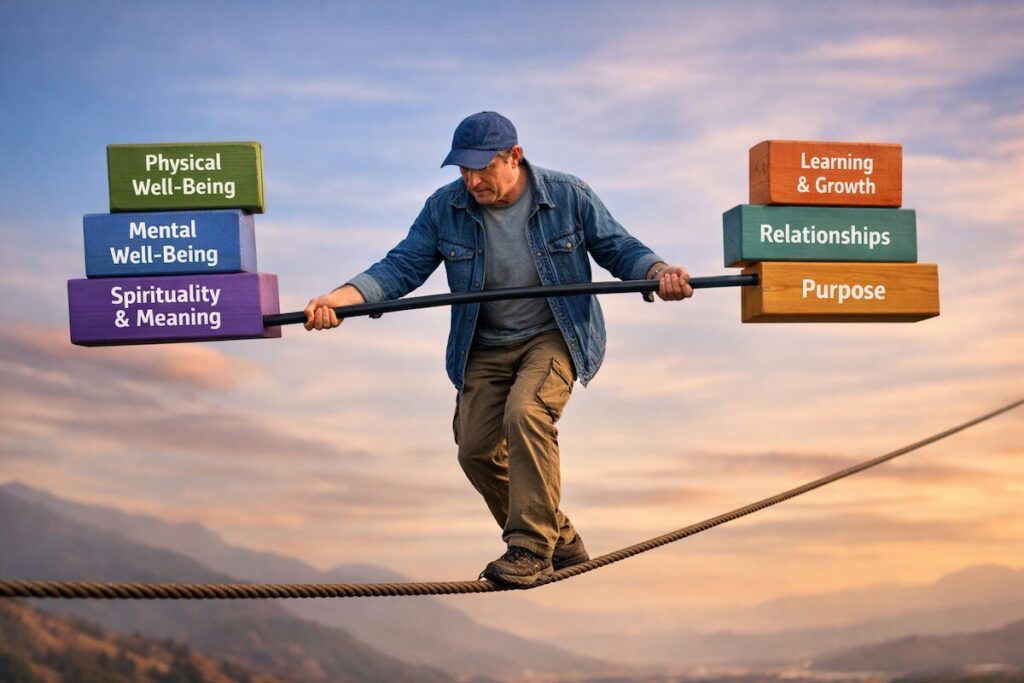
The Six Categories That Define a Beautifully Balanced Life
1. Physical Well-Being
Your body is the vessel for everything else. Without it, none of the other categories matter as much, which is why physical well-being deserves a real and consistent place in your life — not as a vanity project, but as an act of deep self-respect.
This doesn’t mean you need to train like an athlete. It means you’re moving your body regularly, getting enough sleep, nourishing yourself with food that makes you feel good, and staying on top of the health check-ins that your age makes increasingly important. It means listening to your body rather than overriding it.
For people in their 50s plus especially, this area often needs a gentle re-examination. The things that worked in your 30s might not work the same way anymore — and that’s okay. What matters is finding a version of physical care that fits the life and the body you have now.
Setting your ego aside and honestly assessing where you are now allows you to focus on improving just 2% each month—in strength, balance, flexibility, cardiovascular endurance, or functional fitness.
This mindset is essential. It’s the foundation I build into every single day, and barring unforeseen circumstances, fitness becomes as consistent in my daily routine as eating and speaking.
2. Mental Well-Being
Your mental and emotional health is every bit as real and important as your physical health, and yet it’s the category that people most often neglect, minimize, or feel awkward tending to.
In reality, if your mood starts tanking, or your thinking gets out of whack, it generally directly impacts your engagement in physical activities at the same time. As one system goes down, it drags the other as well.
Mental well-being isn’t just about managing stress (though that matters a great deal). It’s about cultivating a rich and healthy inner life. It’s about understanding your patterns, your triggers, and your thought habits.
It’s about making sure you have enough space in your life to process what you’re experiencing — honest conversations with trusted people, time spent in nature, journalling or even therapy if you feel you would benefit from it, or whatever helps you feel clear and grounded.
When this category is neglected, it tends to show up everywhere else — not just your engagement in movement but also in your relationships, your motivation, and your sense of purpose. It’s foundational in a way that’s easy to underestimate until it starts to crack.
3. Spirituality and Meaning
I want to be careful here, because spirituality means very different things to different people — and all of those meanings are valid. For some, this is a traditional religious faith. For others, it’s a deep connection to nature, or to something larger than themselves that they can’t quite name but can definitely feel. For others still, it’s a committed mindfulness, meditation or yoga practice that keeps them anchored to the present moment.
For some, they’ve ignored the spiritual side of themselves in the first half of life, and only later in the second half do they start to ask deeper questions of a philosophical nature. Whatever form it takes for you, this category is about the recognition that life is bigger than your to-do list. It’s about regularly touching the part of yourself that asks the deeper questions: Why am I here? What truly matters? What do I believe?
People who have a strong sense of spirituality — however they define it — tend to navigate difficulty with more grace, find meaning in more places, and feel a greater sense of connection to the world around them. You can see why it’s essential that this area be included as one of the primary mainstays for living a balanced life.
4. Learning and Growing
Human beings are wired for growth. We are, at our best, endlessly curious creatures. And one of the most reliable sources of joy in life is the feeling of learning something new, stretching your thinking, or developing a skill you didn’t have before.
This category is especially exciting for mature adults, because you now have the gift of wisdom to bring to your curiosity. You’re not learning just to achieve or to prove yourself anymore — you’re learning because it lights you up.
Whether that’s taking a course, picking up an instrument, travelling somewhere new and immersing yourself in a different culture, reading widely, or finally starting that creative project you’ve been putting off for decades — growth keeps you vital and engaged in a way that very little else can. For those in retirement, it’s manifested through the development of small entrepreneurial pursuits, mentoring or taking on new roles within the family structure.
Don’t let this pillar quietly disappear under the weight of routine. Your brain wants to be challenged. Give it something good to work on.
5. Relationships and Social Connection
I don’t think it’s possible to overstate how important this one is. The research is absolutely clear: our relationships — the quality of them, more than the quantity — are one of the strongest predictors of both happiness and longevity. And yet, relationships are also one of the first areas to get deprioritized when life gets busy.
This category includes your romantic partnership if you have one, your friendships, your family connections, and your sense of belonging to a community. It includes the people who know you well and love you anyway, and the newer connections that bring fresh energy and perspective into your life.
In your 50s and beyond, you may find that some of your social circles have naturally shifted — kids are more independent, careers are more settled, and some friendships have faded simply because the shared context that held them together (young children, a particular job, a specific neighbourhood) has changed. This is a natural part of life.
But it does mean that relationships often need a little more intentionality at this stage. Invest in the relationships that matter. Make the calls. Plan the dinners. Show up.
And if too many of your relationships have disappeared, which is common believe me, start fresh. We were never intended to wallow in isolation once our core relationships fade away. We were supposed to grow and be challenged to make new ones. Look up, look out, and move forward.
I know it feels scary. It seems so simple, doesn’t it? Something even 4-year-olds can do with ease. And yet, here we are, despite all our knowledge, skills, experience, and competence, unable to find a way to do it or summon the courage to be vulnerable and brave enough to reach out and make new friends.
Why is this the case? What is so terrifying that many allow this aspect of their lives to fade away, even when they know—deep down—and others warn them that lacking social connections is harmful to their wellbeing? I wish I understood. If we truly grasped the root cause, there would be far more support available to help those struggling. I’m certain of that. Instead, we’re all left to navigate this challenge alone, trapped in isolated little worlds, trying to find our own way.
I intend to write a lot more on this in the future as it’s such a fascinating and concerning ailment within our current culture.
6. Purpose
This is the category that ties everything else together. Purpose is the answer to the question: What am I here to contribute?
It doesn’t have to be grand or world-changing. Your purpose might be raising conscious, kind humans. It might be your creative work. It might be the way you show up for the people in your community. It might be the business you’re building or the cause you’re quietly committed to. What matters is that you have a sense of it — a feeling that your presence in the world makes some kind of difference, however large or small.
Without a sense of purpose, even a life full of comfort and activity can start to feel a little hollow. With it, even hard seasons feel like they’re moving toward something. Purpose is the compass. And after 50, with so much of the earlier-stage, striving, behind you, it’s one of the most worthwhile things you can sit down and think deeply about.

Your Annual Life Balance Review
Now that we have the six established categories, I want to give you something practical to do with them. Because knowing about balance is one thing. Creating it is another.
I’d love for you to consider making an Annual Life Balance Review a personal tradition — something you do once a year, ideally around your birthday, the new year, or any other meaningful marker of time passing. Set aside a few hours in a place where you can think clearly. Make it feel special — your favourite coffee shop, a quiet morning at home with something delicious to drink, a solo walk somewhere beautiful.
I even know of one person who treats themself to an annual weekend getaway (same location, same rental unit) for this express purpose. He plans out the whole weekend filled with self-care: a hike in nature, a spa visit/massage, a special restaurant meal, and time set aside to reflect, write and plan at a quaint, inviting coffee house close by to where he stays.
The primary focus of his reflection: is my life still balanced or does it need a re-design? What in this past year was valuable and fulfilling? What experiences enhanced my life? Who came into it, and which relationships do I need to recharge? What can I re-design for better balance? What needs attention? Do I have a dream still (and I hope he does)?
Here’s a simple way to approach it:
Step One: Rate each category. On a scale of one to ten, how present and nourishing is each of the six areas in your life right now? Don’t overthink it. Your gut answer is usually the truest one because it isn’t about a pure quantitative measure, but what meets your personal and unique needs.
Step Two: Notice the gaps. Which pillars scored the lowest? Which ones have been quietly neglected — maybe so quietly that you hadn’t even noticed until right now? Or maybe you already know which areas you are disappointed with and you feel a very strong intuitive knowing that this area must be your primary focus for the coming year.
Step Three: Get specific. For each category that needs attention, brainstorm 2-3 concrete things you could actually do to strengthen it. Not vague intentions — real, schedulable actions. A weekly walk with a friend. A monthly visit to a place of spiritual meaning. A course you’ve been eyeing for months. A standing date night. An hour a week to work on that creative project.
Step Four: Build it into your schedule. A plan without a calendar is just a wish. Look at your actual week and decide when these things are going to happen. Protect that time the way you’d protect any other important commitment.
Step Five: Revisit quarterly. You don’t have to do the full review four times a year, but a quick check-in — even just journaling for twenty minutes — can help you catch a drift before it becomes a problem.

A Few Ideas in Your Pursuit of Balance
If you’re looking at a particular category and feeling a little stuck about how to strengthen it, here are some starting points:
Physical Well-Being: Morning walks, working with a personal trainer, swimming, cycling, strength training, committing to regular sleep, cooking more whole foods at home, joining a league of some sort, scheduling your annual health appointments.
Mental Well-Being: Journalling, meditation or breathwork, digital detoxes, honest conversations, time spent in nature, creative expression, reading, setting better boundaries around your time and energy, and a few therapy sessions never hurt anybody if you think that may be for you.
Spirituality: Attending a religious service, developing a meditation practice, spending intentional time in nature, exploring a philosophy or spiritual tradition that resonates with you, volunteering, practicing gratitude, creating rituals that bring you back to what matters.
Learning and Growing: Online courses, in-person workshops, reading outside your usual genre, learning a language, picking up an instrument, travelling somewhere unfamiliar, mentoring someone younger, joining a book club or discussion group, going after that promotion at work, retraining for a different line of work, or starting up a small business. Stretching yourself for personal growth is where it’s at.
Relationships and Social Connection: Regular one-on-one time with the people who matter most, hosting more gatherings, joining a club or group organized around something you love, being the person who initiates rather than always waiting, joining a meetup in your area (www.meetup.com) writing actual letters or notes to people you care about.
Purpose: Volunteering with an organization whose mission moves you, clarifying your personal values, starting a creative project, getting involved in civic issues, caring for others, mentoring, exploring a new career direction, building something that outlasts you — a business, a community, a body of creative work.
The Coolest Bonus In All of This
The most powerful insight I discovered—and your secret weapon—is that a single redesign often influences multiple areas of your life simultaneously. For instance, if you decide to increase your physical activity by learning a recreational sport like badminton, you’ll not only get more exercise but also meet new people, enhancing your social connections.
At the same time, you’re acquiring new skills, stimulating your mind. The combination of physical activity and positive social interactions boosts your brain chemistry, improving your mood and mental health.
This shows how one simple change can create a ripple effect, impacting various interconnected aspects of your life. Even a small 2% adjustment can lead to a transformative 40% improvement overall.
The Gift of This Season
And if you’re now pivoting from career to next chapter, you are in an extraordinarily good position to create a beautifully balanced life.
The achieving stage — the one that consumed so much of your 20s, 30s, 40s and early 50s — is largely behind you. You’ve built things. You’ve proven things. You’ve learned things the hard way.
And if your children are older and more independent, if your career is more settled, if you have a little more financial breathing room — all of that gives you something priceless: space. Space to finally design your days the way you want them to look, not just the way circumstances demand.
That doesn’t mean life is suddenly easy or simple. It just means that the tools are in your hands in a way they perhaps weren’t before.
A beautifully balanced life won’t happen accidentally. But it absolutely can happen intentionally. And the joy that comes from living that way — feeling nourished in your body, clear in your mind, connected in your relationships, growing in your curiosity, grounded in your spirit, and alive in your purpose — that joy is real, and it is available to you.
Start with the assessment. One category at a time. One small, intentional shift after another.
That’s how a beautifully balanced life actually gets built.
What’s been your experience with a re-design to put your life in better balance? Or, is there an area you find you consistently let slip without realizing it?
I have a YouTube channel on many topics related to life after 50 here in Canada.

Leave a Reply